
Tokyo Rose never existed. No one at Radio Tokyo ever used the name on air, and US government monitors listening around the clock never heard it. Yet in 1949 a federal jury in San Francisco convicted a 33-year-old American of treason for being the fictitious figure.
“…Tokyo Rose was not an actual person, but the fabricated name given by soldiers to a series of American-speaking women who made propaganda broadcasts under different aliases.” - FBI
Most propaganda runs from a state to an audience, but this one ran backwards. The audience wrote the character, the press cast an actress, and the government supplied the ending.
It was not a false flag in the strict sense, as nobody in Washington planned it (insofar as we know). But the end state was the same: an enemy operation that was substantially American-made, pinned on a face that fit. (cue Give the People What They Want by The O’Jays)
The Audience Invents the Propagandist
The name was in general use among Allied troops by the summer of 1943. It was a catch-all for any English-speaking woman heard on Japanese radio, and there were several, broadcasting from different cities under different aliases.
Rumor did the rest. In the retelling, Tokyo Rose named units, knew where ships were headed, predicted attacks, and taunted men about unfaithful wives at home. She was seductive and omniscient. She was also, in that form, a figure nobody had recorded.
The US government said so itself. In August 1945, weeks before the reporters reached Tokyo, the Office of War Information concluded: “There is no Tokyo Rose; the name is strictly a GI invention.” Its monitors, it added, “have never heard the words Tokyo Rose over a Japanese-controlled Far Eastern radio.”
Note the sequence: the legend existed before the woman later convicted of being its author had spoken a word on air.
The Press Casts the Part
Iva Toguri was born in Los Angeles on July 4, 1916, and graduated from UCLA with a bachelor’s in zoology. In July 1941 she sailed to Japan to help care for a sick aunt, and Pearl Harbor stranded her there.
She was pressed to renounce her US citizenship and refused. That made her an enemy alien, denied a ration card, so she found work as a typist, eventually at Radio Tokyo.
In November 1943 she was put on “The Zero Hour,” a program broadcast by Japan featuring Allied prisoners of war: Australian Major Charles Cousens, US Army Captain Wallace Ince, and Philippine Army Lieutenant Norman Reyes. The POWs wrote the scripts and worked to blunt them with sarcasm, flubs and double meanings. Toguri introduced records for a few minutes a show as “Orphan Ann,” for about 150 yen a month, some of which bought food she smuggled to POWs.
A later US Army analysis found the show did no harm to troop morale and “it might even have raised it a bit.”
Then Japan surrendered and the reporters arrived. Clark Lee of Hearst’s International News Service and Harry Brundidge of Cosmopolitan wanted the scoop on “the hottest story in Japan Today”: Tokyo Rose. They offered $2,000 for an exclusive, about a year’s wages in occupied Japan.
Broke and trying to get home, Toguri took the meeting on September 1, 1945 and signed a contract identifying her as the “one and original” Tokyo Rose. The money was never paid, and Brundidge shopped his notes as her confession. Toguri was arrested within days.
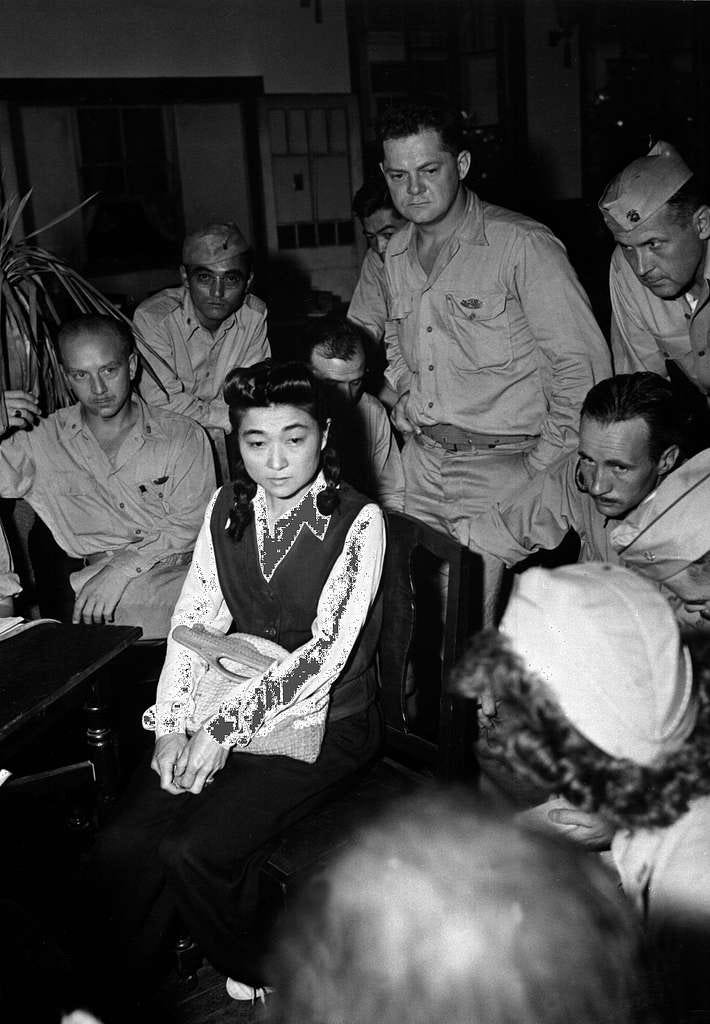
That signature is the hinge of the whole case. A myth with no author now had a name, a face and a document.
The State Supplies the Ending
The first investigation cleared her. She was held about a year in Japan and released in October 1946, after the Army, the FBI and the Justice Department found the evidence did not merit prosecution. The Eighth Army’s legal section found no evidence she “ever broadcast greetings to units by names or location, or predicted military movements or attacks.” In other words, none of what the legend said Tokyo Rose did.
The facts were settled, but the story was not. When Toguri applied to come home, pregnant and wanting her child born on American soil, radio columnist Walter Winchell and veterans’ groups campaigned against her. The public had been promised Tokyo Rose and wanted her tried.
‘TOKYO ROSE’ IN CUSTODY; U.S.-Born Woman Faces Treason Trial in San Francisco
— The New York Times, August 26, 1948
The Justice Department reopened a case it had already judged empty. She was arrested in Tokyo on August 26, 1948 and brought under military guard to San Francisco, arriving September 25. By the FBI’s own account, Brundidge, the reporter who had bought the signature, enticed a contact to perjure himself. The witness, Hiromu Yagi, told the grand jury he had watched her broadcast propaganda, then admitted to the FBI he had never seen her broadcast at all. Brundidge was not prosecuted, and neither man was put on the stand.
The trial opened July 5, 1949, the day after her 33rd birthday. It ran twelve weeks and cost more than $750,000, the most expensive in US history to that point. Cousens, already cleared in Australia, testified for her.
The all-white jury acquitted on seven of eight counts. The one that stuck, Count VI, reads:
“...on a day during October, 1944, the exact date being to the Grand Jurors unknown, said defendant, at Tokyo, Japan, in a broadcasting studio of the Broadcasting Corporation of Japan, did speak into a microphone concerning the loss of ships.”
No date, and no recording or script of the line itself. The records played in court served to identify her voice, and many scripts and recordings had been lost or destroyed while in government hands. The count rested on station witnesses, chiefly Kenkichi Oki and George Mitsushio, who said they watched her say it. She got ten years, a $10,000 fine and the loss of the citizenship she had refused to give up in wartime Tokyo. The judge, Michael Joseph Roche, later admitted to harboring “anti-Japanese prejudice.”
She served six years and two months at Alderson, West Virginia.
The Unwinding, 28 Years Late
In 1976 Chicago Tribune correspondent Ron Yates tracked down Oki and Mitsushio in Japan. Both said they had lied. They told Yates that the FBI and occupation police had coached them for more than two months and threatened them with treason trials of their own if they did not cooperate.
60 Minutes followed in June 1976. The jury foreman, John Mann, said on camera that he had believed she was innocent and should have stuck to his guns.
On January 19, 1977, his last full day in office, Gerald Ford granted a full and unconditional pardon and restored her citizenship. It remains the only such pardon ever given for a treason conviction.
In January 2006, the World War II Veterans Committee gave her its Edward J. Herlihy Citizenship Award. The men the legend said she had demoralized were the ones honoring her. She died that September in Chicago, aged 90.
The Mechanism
Strip the names off and the mechanism is portable.
Rumor fills a vacuum. Scattered real broadcasts, heard through static by frightened and bored men, consolidated into one all-knowing woman. A single villain is easier to carry than a dozen forgettable announcers.
Naming makes it real. Once the voice had a name, she had an existence that official denial could not touch. The OWI said she was a GI invention. Nobody cared.
The market demands a body. A character that famous is a scoop waiting to be claimed. Two reporters did not find Tokyo Rose. They purchased one, with a contract and a price.
The record gets built to match the story. With a signature in hand and a public primed, the state reversed its own finding and assembled testimony to fit the verdict the audience already held. A verdict certified the myth.
Correction costs more than creation. The myth took a summer to form. Undoing it took a foreign correspondent, a network broadcast and a presidential pardon, three decades on.
This is why “almost false flag” is the right frame, and why “almost” is doing work. A false flag needs a planner. This had none. Soldiers, columnists, reporters and prosecutors each acted on their own incentives, albeit inducing others, and the sum was indistinguishable from a designed operation.
That is the uncomfortable part. The most durable propaganda in this story was not Japan’s, which, by the Army’s own analysis, did not work. It was the American story about Japan’s propaganda, which worked so well it sent an American to prison.
And it still works. “Tokyo Rose” endures as shorthand for a traitor’s voice.
The name outlived the pardon.